

The Critics Agree: Loser* Doesn't Totally Suck!
Reviews are in from Kirkus, Publisher's Weekly (sort-of), and IndieReader!

So here’s how it works when you’re self-published: no one knows who you are or if your book is total garbage. And since a lot of self-published books are total garbage, it’s safe to assume that yours is too. The traditional book publishing world doesn’t have the ambition to discover new authors because it’s more lucrative to chase YouTube stars and celebrities who are willing to have a ghost writer tell the story about how they got run over by a snowplow. So trying to tell people about your book is hard unless you are a YouTube star or a celebrity who got run over by a snowplow. Unfortunately, I am neither.
Oh what I would do for a snowplow to run me over…
But as a devoted Batman fan, I have learned one thing about making a difference in this world: you don’t need super powers if you have buckets and buckets of money.
I have some buckets of money, fewer than I would like, and most of it is in a bank and not in a bucket—but because of this money, I can just pay people to write a book review. They actually read the book, and they send an honest review to you. If your book sucks—and it probably does—you get to read the shitty review ahead of time and choose whether or not to make it public. There are two main services that do this: Kirkus and BookLife.
BookLife is the same as Publisher’s Weekly, except it’s…well…I don’t actually know the difference. And then there is a BookLife Prize, which is a different review, and you might when a prize. But neither are technically Publisher’s Weekly reviews, but the reviews are written by the same people who write the Publisher’s Weekly reviews, and you can pay to have them printed in Publisher’s Weekly, but you can’t call them Publisher’s Weekly reviews, but they are.
So rather than trying to make sense of all this, I just emptied one of my money buckets and ordered a review from both of these services. And then apparently I also bought one from IndieReader. Which I don’t remember doing.
And the reviews are good! How about that!
•••
Here they are:
Kirkus:1

Beaty’s memoir chronicles his days as an awkward midwestern youth in the early 2000s.
This work chronicles the author’s adventures in love, relationships, faith, and growing up in Grand Island, Nebraska. Beaty writes that, from his days in elementary school in the 1990s through middle school, he “couldn’t figure these girls out, so [he] stopped trying.” He took up the drums in fifth grade and found good friends in the school band. He was shocked to discover, via associations with a series of non-denominational evangelical churches, that these friends were possibly on the road to eternal damnation. (“It had never occurred to me that people I knew were going to hell, I figured that was one of the perks of growing up in the United States.”) Although he was outwardly gregarious in high school, dating and girls continue to baffle him; Beaty had a girlfriend for two weeks after his sophomore year before she broke up with him, and he turned a homecoming date his junior year into a fiasco, embarrassing both his date and himself. He participated in the school band drumline, played in a series of groups, joined a trapshooting team, and worked. During his senior year, a mission trip to Mexico opened his eyes “to the place of privilege [he] came from,” and an influential English teacher provided rewarding feedback on his writing. Graduating in 2008, he left Grand Island to study architectural engineering at the University of Nebraska, Omaha. Omaha became his home, and he finally met a woman he felt secure with—his future wife, Paige. Beaty’s humorous style accurately conveys the changing perspectives of adolescence. He writes with great insight about his awkwardness and confusion while growing up in Nebraska, where “You tried to stand out by looking and acting exactly like everyone else.” The school photos at the beginnings of each chapter nicely juxtapose Beaty’s physical growth with his emotional maturation, and music playlists effectively evoke the era.
This wry account will resonate with anyone who’s survived high school.
•••
BookLife by Publisher’s Weekly:2
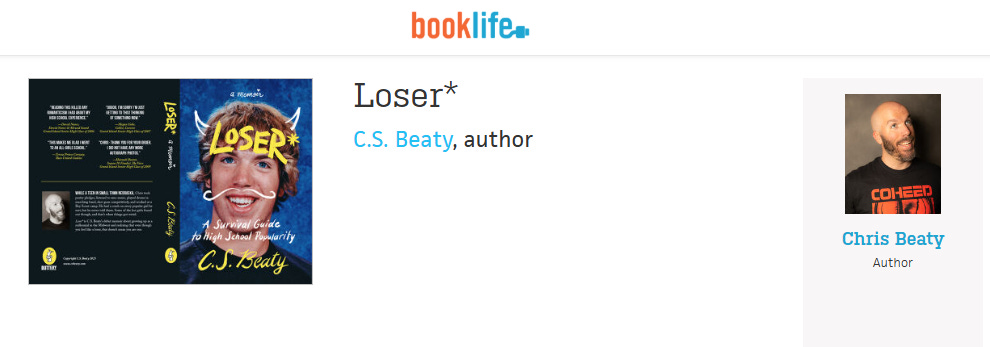
“High schoolers are method actors,” writes Beaty in the opening to his candid debut memoir. Charting a comprehensive journey through his school life in Grand Island, Nebraska, he zeroes in on his time in Grand Island Senior High as the focal point, recounting stories of lost love, youthful drama, and the various tactics he used to impress his crushes along the way. From band practice and trapshooting to Boy Scout camp and youth group, Beaty scours every inch of his stagnant town for a place to belong. The memoir follows him into maturity as he confronts his insecurities and rediscovers how to be comfortable, secure, and happy.
Beaty treats readers less like observers and more like friends with his lax, informal style, sweeping them into Grand Island and its many absurdities—from its love of fiberglass ornaments to its irrational hatred of Kearney. His prose is hilariously foul-mouthed, with a sense of humor that teases at intimacy only to rip it away with biting sarcasm: “I was never able to recapture that horny burst of hormones from that night when our denim covered butt cheeks connected, so I didn’t do anything.” The number of characters can be daunting, but each resident has their place and adds to the book’s communal feeling.
The memoir’s jaunty humor can be deceptive. Underneath the pop culture references and innuendos are heartbreaking depictions of self-loathing. As Beaty grows up, so, too, does the narrative. A self-professed high school “loser,” his internalized mistakes follow him far outside the classroom. Reflecting on a squandered love, he cuts to the core of the issue: “Her biggest flaw, the one I couldn’t forgive, was that she liked me.” Readers who remember the angst of high school days will resonate with this piercing memoir on insecurity—and how teenage experiences are far from as simple or damning as they may appear.
Takeaway: Piercing memoir on high school’s insecurities and struggles for belonging.
Comparable Titles: Stephen Chbosky’s The Perks of Being a Wallflower, Tegan and Sara’s High School.
Production grades
Cover: A
Design and typography: A
Editing: B+
Marketing copy: B+
•••
The BookLife Prize:3
Plot/Idea: Loser traces Beaty’s adolescence with humor, self-awareness, and a clear affection for the awkwardness of growing up as an evangelical Midwesterner. The high school years form the book’s emotional and narrative core, offering the strongest material and the clearest sense of momentum. While the memoir includes earlier childhood and post-high school chapters, those sections can feel more perfunctory, as though included out of convention rather than necessity. Loser is at its best when it stays grounded in the claustrophobic intensity and social hierarchies of adolescence.
Prose: Beaty’s prose adopts a deliberately nonchalant, conversational tone that is deceptively difficult to pull off, but one he largely succeeds in sustaining. The writing is funny, self-deprecating, and precise, especially in its accumulation of culturally specific detail: Netscape browsers, instant messaging, mixtapes, and the ambient anxieties of late-1990s teen life. Occasionally, the narrative circles back on itself or feels slightly choppy, revisiting ideas that have already been addressed, but the voice remains engaging, inviting readers to laugh along with the narrator.
Originality: The book’s originality lies less in its subject matter than in its writing and relatability. Beaty manages to render familiar experiences—religious guilt, adolescent competitiveness, friendship dynamics—with humor and genuine insight. Moments of poignancy, particularly around faith and friendship, add emotional resonance. At times, however, these more serious passages arrive abruptly and sit uneasily alongside lighter chapters, leaving readers unsure whether the memoir is charting a spiritual reckoning or primarily offering a comic coming-of-age story.
Character/Execution: Loser depicts Beaty's messy, emotional, and awkward high school years in a way that many readers will identify with and find charmingly funny. He possesses an excellent eye for details—such as the inclusion of his school photos and humorous blurbs—that helps Loser stand out, and the chapters covering his high school years are a delightful standout.
Score:
Plot/Idea: 9/10
Originality: 8/10
Prose: 9/10
Character/Execution: 9/10
Overall: 8.75/10
•••
IndieReader:4
LOSER*: A Survival Guide to High School Popularity begins with a story on Lake Tahiti about reed island life, and author C.S. Beaty dwells on it at length. Throughout his memoir, Beaty tends to wander away from the main subject—often discussing secondary topics that can be funny or connect to the chapters in a roundabout way. The book serves as a user manual for surviving high school, making the interesting point that teenagers play roles as they aspire to identify with the “part” they emotionally assume. Beaty also highlights self-consciousness by implying that many people suffer from an identity crisis.
The references to Blockbuster and Hot Topic situate Beaty firmly within the next generation, resonating with Generation Y readers. At the core of the book is a clear fondness for his hometown Grand Island, Nebraska, including jokes such as, “It’s not an island, and it’s not grand.” His self-deprecating humor encompasses himself, his town, and his stories, and the tone is one of fond reminiscence (both sarcastic and affectionate).
Beaty’s use of ingenious metaphors demonstrates the audacious way he laughs at himself, especially in his descriptions of the “Coney Island Lunch Room” and various yearbook pictures and quotes. These moments feel like inside jokes for those attuned to his style. The meticulousness and absurdity of his prose serve as his superpowers. Sometimes his detailed attention and love for the absurd cause an anecdote or two to stretch a bit too long, or a joke to land only for readers who grew up in the same era or region. This is the trade-off with a memoir so rooted in its time and place: readers who share those experiences will find it a treat, while others may occasionally feel left out. The frequent Generation Y shout-outs and winding explanations can leave the narrative feeling somewhat loose around the edges, but, in a strange way, that imperfection suits the story that Beaty is telling.
LOSER is a comedic and heartwarming collection about adolescence and forgotten contemporary trends, offering readers much to relate to and adore. Beaty creates a sense of connection for readers who may see their own struggles and growth in his childhood. Overall, the blend of humor and heartfelt reflection makes this collection especially rewarding for anyone who has ever felt out of place or nostalgic for the past.
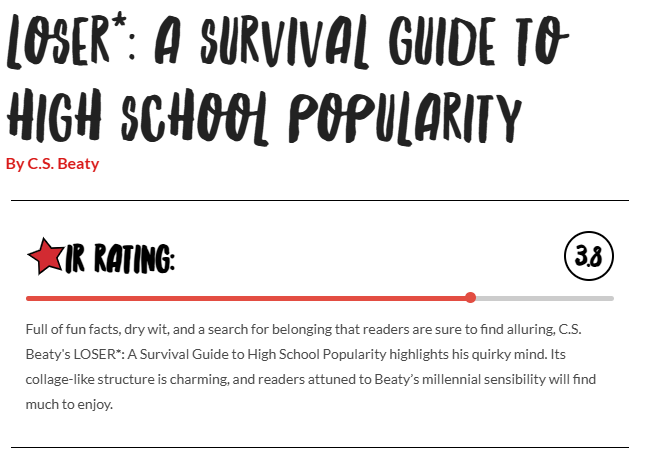
Full of fun facts, dry wit, and a search for belonging that readers are sure to find alluring, C.S. Beaty’s LOSER*: A Survival Guide to High School Popularity highlights his quirky mind. Its collage-like structure is charming, and readers attuned to Beaty’s millennial sensibility will find much to enjoy.
•••
So that’s fun.
If you happened to read Loser* and also liked the book, please add your own review to Amazon, Good Reads, or any other places where you can click a number of stars on things. This stuff actually make a big difference when you’re an unknown. Maybe. I don’t really know. But it makes me feel nice.
If you hated the book, don’t worry about leaving a review. Just buy a bunch of copies to give out as white elephant presents next Christmas. Or you can lie. I’m ok with lying.
You should also look at my website for more book info including: author appearances, photos of me with celebrities that didn’t want to take a picture with my book, bad senior photo shoot images, other things people said about my book, pictures of my hockey puck collection, and a link to my book’s Spotify playlist.
www.csbeaty.com
Thank you everyone who has supported my writing thus far! Those little bits of encouragement go a long way.
-Chris (not C.S.)


https://www.kirkusreviews.com/book-reviews/cs-beaty/loser-Beaty/
https://booklife.com/project/loser-105599
https://booklife.com/affiliates/pw-expertise-results/b016ab50-f0c3-11f0-8223-547275647911
https://indiereader.com/book_review/loser-a-survival-guide-to-high-school-popularity/
That was fun, reading the reviews. I must find more time for reading... maybe trade in some daily news updates for reading!? Good job!
Congratulations Chris! These are some top tier review sites!