


Introducing retired newspaper reporter, Wahoo, Nebraska historian, and not my real uncle: Uncle Bob Copperstone.
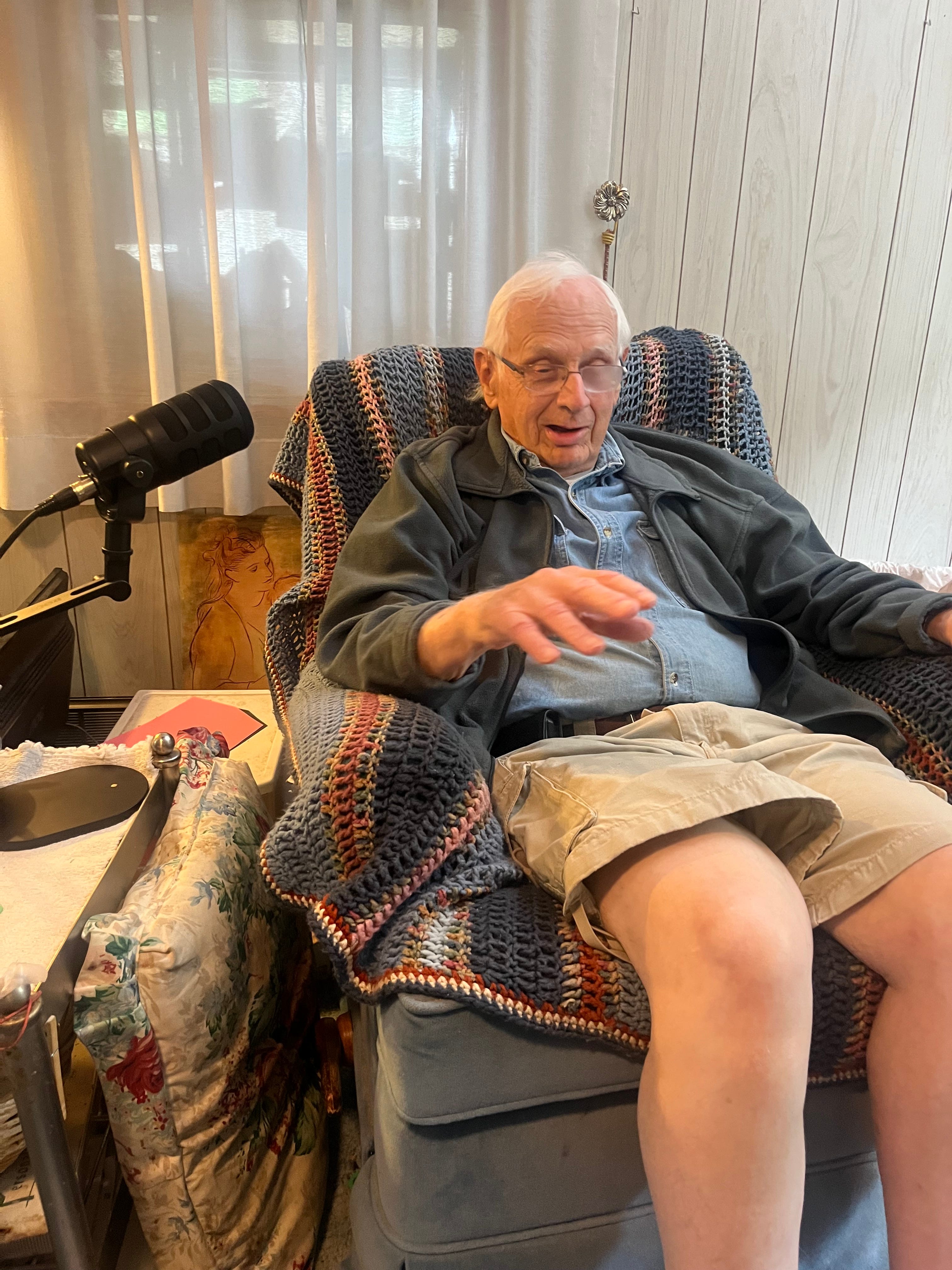
Today’s guest is retired journalist,
(00:00:33):
Wahoo,
(00:00:34):
Nebraska historian,
(00:00:36):
and not my real uncle,
(00:00:37):
Uncle Bob Copperstone.
(00:00:41):
All right, you ready for this?
(00:00:43):
Ready as I’ll ever be.
(00:00:45):
Okay, so the idea behind this podcast is to convince people that they’re interesting.
(00:00:50):
Do you need to be convinced that you’re interesting?
(00:00:52):
I feel like you probably already know that.
(00:00:54):
What makes you interesting?
(00:00:56):
Oh, hell, I earned it.
(00:00:59):
How’d you earn it?
(00:01:01):
By being interesting for so long.
(00:01:03):
Okay.
(00:01:04):
When did you first start being interesting?
(00:01:06):
I never stopped.
(00:01:08):
You were born that way?
(00:01:09):
I was born that way.
(00:01:10):
All right.
(00:01:11):
So you’re born in Wahoo, right?
(00:01:13):
Isn’t everybody?
(00:01:14):
Oh, I guess I was wrong.
(00:01:15):
Everybody that matters, huh?
(00:01:16):
That’s true.
(00:01:18):
All right.
(00:01:18):
So here’s the list.
(00:01:19):
I made a list of things that I knew about you.
(00:01:20):
So you’re born in Wahoo.
(00:01:22):
You helped run the family-owned Wigwam Cafe as a kid.
(00:01:26):
At some point, you moved to California, and you became a newspaper reporter.
(00:01:31):
You’re married at some point, I think.
(00:01:33):
You don’t really talk about it to me.
(00:01:34):
And then at some point you drove a truck cross-country picking up antiques.
(00:01:38):
You told me that once.
(00:01:40):
And then you moved back to Wahoo to retire.
(00:01:42):
Was that about right?
(00:01:43):
That’s about right.
(00:01:44):
Okay.
(00:01:44):
Why did you decide to become a reporter then?
(00:01:48):
Ever since I was in high school, I was a bad student.
(00:01:54):
Mediocre Ds and Cs.
(00:01:59):
And I thought,
(00:01:59):
well,
(00:02:00):
at one of the classes,
(00:02:03):
a civics class,
(00:02:05):
the teacher asked us what we want to do when we get elderly.
(00:02:15):
And I thought, well, I want to be a reporter.
(00:02:20):
Well, that goes back quite a way.
(00:02:23):
Did you know any reporters?
(00:02:24):
Why did you tell her you wanted to be one?
(00:02:28):
Well, wasn’t Clark Kent a reporter?
(00:02:33):
So you saw a little Superman in yourself?
(00:02:35):
Probably.
(00:02:38):
At least a close friend.
(00:02:42):
Anyhow,
(00:02:45):
I started,
(00:02:47):
when I went to California,
(00:02:49):
or before I went to California,
(00:02:52):
I worked at the Bellevue Press.
(00:02:55):
right after graduation and I had that in front of me and I worked in a print shop,
(00:03:05):
a newspaper print shop here in Wahoo and in Bellevue.
(00:03:12):
And in Bellevue they let me work,
(00:03:15):
they let me interview a guy who lived in a trailer court and had a thousand
(00:03:23):
Tropical Fish in it and then their name was Trout.
(00:03:27):
And so I made a little story out of that and they printed it on the front page.
(00:03:32):
Since I was working on the press,
(00:03:36):
the big cylinder press that printed the paper,
(00:03:41):
I was able to print my own first,
(00:03:43):
my first byline.
(00:03:47):
I both wrote it and printed it.
(00:03:52):
And I still have that.
(00:03:54):
Anyhow,
(00:03:54):
I started with the newspapers there,
(00:03:56):
then I went to California after a year in Bellevue.
(00:04:00):
I had gotten a Triumph TR3 sports car, an English sports car, and I drove that to California.
(00:04:12):
I mailed the passenger seat ahead of time and put all my belongings on that spot.
(00:04:25):
I drove to California.
(00:04:27):
Got a job at a print shop there.
(00:04:30):
While I was looking for work, I didn’t know how to type.
(00:04:38):
And I asked the managing editor of the paper that I wanted to work at.
(00:04:43):
He says, fill this out.
(00:04:44):
And I said, can I use, can I write?
(00:04:48):
Can I fill it out with a written one?
(00:04:51):
And he says, yeah.
(00:04:53):
But, of course, I didn’t get that job.
(00:04:57):
What made you want to go to California?
(00:04:59):
Why didn’t you just get a job closer to Nebraska?
(00:05:02):
Well,
(00:05:02):
I did work as a printer’s devil at the Wahoo newspaper in the print shop when I was
(00:05:08):
still in high school.
(00:05:12):
When I worked in Bellevue, I lived in a flop house on 13th Street in Omaha.
(00:05:20):
And I had my time off tier 3 then.
(00:05:22):
And I spent one winter in Omaha driving through that little sports car,
(00:05:29):
trying to drive that through the snow.
(00:05:31):
This ain’t for me.
(00:05:34):
California calls.
(00:05:35):
Took off between snowstorms.
(00:05:38):
I drove as far south as I could to get out of that blizzard and carried it all the
(00:05:44):
way to California.
(00:05:46):
In your sports car?
(00:05:48):
Yeah.
(00:05:49):
Did you have a job then or you just decided to get out of the winter?
(00:05:52):
I stayed with my aunt and uncle.
(00:05:53):
They lived there since the 40s and that was my shelter.
(00:05:59):
Did you get a job after you moved or did you have a job lined up already?
(00:06:02):
No, I went job searching.
(00:06:05):
I ended up at a print shop in San Gabriel that printed wedding invitations and so
(00:06:12):
forth and that carried me through for about a year.
(00:06:18):
And I decided to, I wasn’t making it at that print shop.
(00:06:23):
I wasn’t making enough money.
(00:06:25):
So I quit there and decided, my cousins were fuller brushmen.
(00:06:37):
And I became a fuller brushman.
(00:06:41):
Of the door-to-door salesman?
(00:06:43):
Selling brushes?
(00:06:45):
Selling brushes.
(00:06:47):
Were you good at it?
(00:06:49):
Well, I went from door to door.
(00:06:54):
I didn’t, I was too shy to meet people.
(00:06:58):
I’d go door to door.
(00:06:59):
I’d say, nobody home, I hope, I hope.
(00:07:02):
You’d mutter that to yourself?
(00:07:02):
I’d mutter that and then plow it on through.
(00:07:05):
And if I got somebody’s attention,
(00:07:07):
I just held them there with,
(00:07:09):
practically grabbed them by the collar and told them to listen to what I have to
(00:07:12):
say.
(00:07:14):
And I didn’t do well at all.
(00:07:18):
I drove back to Wahoo.
(00:07:20):
What was your pitch to sell fuller brushes?
(00:07:24):
They last for a good long time.
(00:07:27):
Did they?
(00:07:28):
Whatever they’re looking at, that’ll last for a good long time.
(00:07:32):
Somehow I thought that would be magic, but it didn’t work.
(00:07:39):
It’s, uh...
(00:07:42):
So I went back to Wahoo.
(00:07:43):
So you went to, you’re a fuller brush salesman in California, you went back to Wahoo after that?
(00:07:47):
Mm-hmm.
(00:07:48):
Okay.
(00:07:48):
Yeah, I was kind of discouraged.
(00:07:50):
Oh, I was going to go to school.
(00:07:51):
Okay.
(00:07:52):
And I did.
(00:07:53):
Okay.
(00:07:53):
I went to the University of Nebraska.
(00:07:56):
Back to Lincoln, went to school.
(00:07:59):
Oh, when I came back from California, oh, I took, taking classes by mail.
(00:08:06):
From California?
(00:08:08):
No, from Wahoo.
(00:08:09):
Did you ever actually go to class in Lincoln?
(00:08:12):
Or was it all by mail?
(00:08:14):
Yeah, I did.
(00:08:14):
I took French class about a semester.
(00:08:18):
There was a print shop course.
(00:08:21):
Okay.
(00:08:24):
It was in the basement of one of the buildings there.
(00:08:27):
And I really took to the print shop work, type of work.
(00:08:33):
I did that real well.
(00:08:36):
So I thought well I’ll quit my job here but my grades were falling real bad at the university.
(00:08:44):
That’s when I went to Bellevue.
(00:08:47):
I was doing real well at the print shop there at the university that I thought I’d
(00:08:51):
get a job doing the same thing and get paid for it.
(00:08:56):
So I worked for the Bellevue Press for about a year and decided I’d go back to
(00:09:04):
California and look for a job.
(00:09:07):
All right.
(00:09:08):
So you grew up in Wahoo.
(00:09:09):
You went to California, became a fuller brush salesman, came back.
(00:09:14):
Went to school,
(00:09:18):
got a job,
(00:09:19):
took a bunch of classes and got a job in Bellevue,
(00:09:21):
and then you decided to go back to California in order to get a reporting job,
(00:09:26):
a newspaper job.
(00:09:28):
And I did.
(00:09:28):
I told the editor there, I’ll work for a dollar an hour.
(00:09:32):
Yeah.
(00:09:33):
And they hired me and liked it.
(00:09:37):
As a reporter?
(00:09:39):
As a reporter, yeah.
(00:09:40):
I had my own paper, a little weekly paper.
(00:09:44):
I went to a city council meeting, my first one.
(00:09:48):
That was part of the job.
(00:09:50):
You keep track of what the city is doing.
(00:09:52):
And Covina is a town of about $50,000, something like that.
(00:09:54):
That’s small in Los Angeles County.
(00:10:12):
I went there and listened to the little discussions.
(00:10:17):
Went back the next day.
(00:10:19):
Wednesday was press day.
(00:10:22):
And I sat at my desk and Jim, the managing editor, he said, well, Bob, let’s have your story.
(00:10:32):
I sat there and I sat there.
(00:10:34):
Dune came and went.
(00:10:38):
Jim finally says, Bob, where’s your story?
(00:10:42):
I said, Jim, I don’t know what happened.
(00:10:48):
I thought, well, that’s the end of Bob.
(00:10:51):
Jim laughed.
(00:10:52):
Didn’t know what happened with your story?
(00:10:54):
No, I didn’t know what happened so I could write about it.
(00:10:57):
I didn’t know how to write it.
(00:10:58):
Nothing happened of note at the city council meeting.
(00:11:01):
Apparently.
(00:11:04):
I knew what happened.
(00:11:05):
I didn’t know how to put it to words.
(00:11:08):
Jim kind of chuckled.
(00:11:11):
And he got on the phone to the city administrator and said, hey, Joe, what happened last night?
(00:11:20):
And Jim wrote the story for me.
(00:11:22):
Did he give you credit?
(00:11:24):
Did he say it was written by you?
(00:11:25):
No, no, no.
(00:11:26):
Okay.
(00:11:28):
But that was the last time Jim had to write my story.
(00:11:34):
I went to the next one.
(00:11:35):
I went to the library where there were three papers covering it.
(00:11:43):
And I read what they wrote and got this hang of it and was able to write my own
(00:11:51):
stories after that.
(00:11:53):
So you went and you read what other people wrote about the thing that you were
(00:11:57):
supposed to cover?
(00:11:58):
Yes, I read Jim’s story and Farewell is the House Done and I learned from that.
(00:12:07):
All the time learning how to type.
(00:12:09):
Yeah.
(00:12:10):
But it worked.
(00:12:11):
On a manual typewriter?
(00:12:12):
What was that process?
(00:12:14):
You had a manual typewriter and then you... You turn the copy into the back shop.
(00:12:20):
They read it.
(00:12:22):
They put it on a line of type.
(00:12:24):
Cast the lead type.
(00:12:29):
And put that lead type on a...
(00:12:33):
Printing Press and Print Your Paper.
(00:12:37):
Is it just one at a time, every letter at a time, or how do they cast it?
(00:12:42):
No, no, no.
(00:12:44):
They read my copy and type it out on the linotype.
(00:12:49):
There’s a separate machine that you type it into?
(00:12:51):
No, the linotype does.
(00:12:53):
Yeah, yeah.
(00:12:54):
A different person does?
(00:12:55):
Yeah.
(00:12:55):
Okay.
(00:12:57):
I turn in the paper to the back shop.
(00:12:59):
I turn in my paper to the back shop.
(00:13:03):
and story to the back shop and they put it down to type and print it.
(00:13:08):
So a linotype machine,
(00:13:09):
that was what you learned how to use and what you did in Bellevue or is that
(00:13:13):
something else?
(00:13:13):
No, my work stopped there.
(00:13:18):
The reporters don’t do the linotype.
(00:13:22):
But you did when you were in Bellevue, so you did your own?
(00:13:25):
No, I typed my own.
(00:13:27):
Okay.
(00:13:27):
No, I typed
(00:13:29):
When you were a typesetter, didn’t you say you did that before too?
(00:13:32):
Before it?
(00:13:34):
Oh, I see what you’re getting at.
(00:13:36):
No, I never did that.
(00:13:37):
I never had to work the back shot.
(00:13:39):
I never had to print the paper myself as a reporter.
(00:13:44):
Okay.
(00:13:46):
Well,
(00:13:47):
it gets a little more complicated because I ran a Ludlow,
(00:13:50):
which Ludlow Press,
(00:13:53):
Ludlow typesetter,
(00:13:55):
which printed the fancy type.
(00:13:59):
Okay.
(00:13:59):
A larger type that wouldn’t fit on a line of type.
(00:14:06):
So what was your next big story?
(00:14:07):
So were you still covering city council meetings after that?
(00:14:10):
Yeah, you do everything that you expect a little weekly paper to use, yeah.
(00:14:18):
And sometimes it’s interesting, sometimes it’s not.
(00:14:24):
How long ago were you at that newspaper?
(00:14:30):
Actually,
(00:14:31):
the Monrovia Daily News,
(00:14:34):
or Monrovia was another paper in that San Gabriel Valley area,
(00:14:40):
and they hired me as a reporter after that,
(00:14:47):
the one that I had to learn on.
(00:14:51):
And from there, that was a small daily report.
(00:14:59):
And eventually the San Gibe Valley Daily Tribune,
(00:15:04):
which was nearing 100,000 circulation daily,
(00:15:08):
that was a big paper.
(00:15:11):
And they lifted me out of Monrovia and the next step up was the Tribune.
(00:15:20):
And I rose to the assistant city editor of that paper before I retired.
(00:15:32):
And that was the last paper you were at?
(00:15:33):
Yeah.
(00:15:34):
Okay.
(00:15:35):
So what was your duties like as the assistant city editor?
(00:15:42):
They had a staff of about 20.
(00:15:45):
And five photographers.
(00:15:50):
And I was responsible for looking first at the copy that came through those
(00:15:56):
reporters and pass it on to the next editor.
(00:16:02):
Do you have any stories you remember that you had
(00:16:07):
Were some of your favorites?
(00:16:08):
Oh, excuse me, yes.
(00:16:10):
I worked as a reporter for about five years.
(00:16:14):
Then I was an editor.
(00:16:16):
Yeah, I had some good stories when I was a reporter.
(00:16:23):
I had a humorous vein sometimes.
(00:16:29):
And I had my own political...
(00:16:35):
Political writer, editor, writer for a couple of years.
(00:16:41):
Any stick out?
(00:16:42):
What was one that you remember that you thought was good?
(00:16:45):
I was supposed to go to the hotel where Bobby Kennedy was murdered.
(00:16:50):
I was supposed to go to that lay in Los Angeles when I was editor of the political
(00:16:57):
editor,
(00:16:58):
but I couldn’t make it and missed it,
(00:17:00):
so I missed it.
(00:17:04):
Writing an obituary for that.
(00:17:07):
Really?
(00:17:08):
Do you remember why you missed it?
(00:17:11):
I didn’t want to go.
(00:17:12):
Okay.
(00:17:14):
I didn’t want to drive to Los Angeles.
(00:17:16):
So you found an excuse to get out of it, huh?
(00:17:18):
Get out of it.
(00:17:20):
Foolish man.
(00:17:22):
So what made you want to go back to Oahu?
(00:17:24):
Why didn’t you stay in California?
(00:17:25):
My mother was not well, and I was about ready to retire.
(00:17:32):
And you’ve been living in Oahu ever since then?
(00:17:40):
Yeah.
(00:17:45):
California never was home to me.
(00:17:48):
Now my sister Rochelle
(00:17:51):
And my little sister Janie both moved to California too.
(00:17:58):
Janie died pretty much early in life, bless her heart.
(00:18:04):
But Rochelle is still there to this day and that’s home to her.
(00:18:09):
She got married and raised a family.
(00:18:16):
I got married and got a divorce.
(00:18:19):
And so I never set any roots at that point.
(00:18:24):
I should probably clarify you’re not actually my uncle.
(00:18:27):
So whose uncle are you?
(00:18:28):
Everybody calls you Uncle Bob.
(00:18:30):
Rochelle and Janie, my sisters.
(00:18:34):
My niece and my two nieces, Kathy and Tina, are Janie’s children.
(00:18:46):
Actually, to my neighbors, I’m Uncle Bob.
(00:18:48):
Yeah?
(00:18:50):
Everybody, even your neighbors call you Uncle Bob?
(00:18:53):
Some do, yeah.
(00:18:54):
Yeah?
(00:18:56):
Yep.
(00:18:57):
Kind of trips off the tongue.
(00:18:58):
Yeah?
(00:18:59):
Yeah.
(00:19:00):
And I’m so damn lovable.
(00:19:02):
Yeah.
(00:19:03):
You might as well be everyone’s uncle.
(00:19:05):
That’s true.
(00:19:06):
Why not?
(00:19:06):
It doesn’t cost anything.
(00:19:07):
Yeah.
(00:19:08):
My kids are always,
(00:19:10):
they call you Uncle Bob and they try to figure out how you’re related to them too.
(00:19:13):
Oh, is that right?
(00:19:14):
Yes, it hurts.
(00:19:16):
Yeah, that could be kind of, that could be kind of
(00:19:22):
So why do you why do you write so much about the wigwam cafe and your childhood
(00:19:27):
what is It’s for some reason I can’t remember what I had for breakfast But I can
(00:19:41):
remember when I was five years old.
(00:19:43):
I was first day in kindergarten And it just comes to be natural.
(00:19:48):
Yeah
(00:19:48):
It’s just,
(00:19:50):
I mean,
(00:19:51):
down to the,
(00:19:52):
what I was smelling when I first walked outdoors kind of remembrance.
(00:20:00):
It just comes back.
(00:20:03):
And if I’m not exactly on cue, I’m absolutely correct.
(00:20:09):
There’s nobody who’s gonna correct me.
(00:20:15):
I can be Superman’s uncle
(00:20:18):
Nobody would doubt it.
(00:20:20):
Nobody would doubt if you’re Superman’s uncle?
(00:20:22):
That’s true.
(00:20:23):
I won’t challenge you on it.
(00:20:28):
You could bring up figures and dates, but it wouldn’t help me.
(00:20:34):
How much has Wahoo changed since those times?
(00:20:36):
Has it changed a lot or not by much?
(00:20:40):
Just about what you’d expect.
(00:20:43):
Missing some of the good stuff, God knows.
(00:20:48):
But it weren’t all that good.
(00:20:54):
Everybody lives a life that looks better from a distance.
(00:21:00):
Yeah.
(00:21:01):
I’m one of them.
(00:21:03):
Your life looks better from a distance?
(00:21:06):
It’s, well, I’m different from what I was, so so am I.
(00:21:19):
So you would say Wahoo’s changed a little bit,
(00:21:21):
but at the end of the day,
(00:21:23):
it’s still got a lot of the same things or a lot different?
(00:21:26):
I mean,
(00:21:27):
you chose to retire and live here the rest of your life,
(00:21:29):
even after seeing the glamour of Hollywood and California.
(00:21:35):
Well,
(00:21:35):
I tell you,
(00:21:36):
I miss more than that,
(00:21:39):
because I can entertain myself just about anywhere,
(00:21:42):
but more than that,
(00:21:45):
I miss the people.
(00:21:46):
Of Wahoo?
(00:21:48):
Yeah.
(00:21:50):
What do you like about the people of Wahoo?
(00:21:57):
Not much.
(00:21:59):
You want to change your answer then?
(00:22:01):
I wonder about that.
(00:22:05):
Actually, life is the further away from it, the better and the milder it becomes.
(00:22:12):
Well, you have anything else you want to... We’ve been going for about a half hour.
(00:22:15):
That’s pretty good.
(00:22:16):
Anything else you feel like... Any wisdom you want to impart to the world?
(00:22:21):
Any thoughts about... Oh, God, don’t follow me.
(00:22:23):
Don’t follow you?
(00:22:28):
You can do better.
(00:22:29):
No, I... Wahoo people have a sense of humor.
(00:22:37):
And I was born with it and I kept it.
(00:22:41):
I think I owe it to a lot of the people I grew up with who treated me mildly and decently.
(00:22:48):
Bless their hearts.
(00:22:59):
I hope to have a worthwhile
(00:23:10):
lifetime.
(00:23:13):
Sometimes when I wasn’t as human as I thought I should be, I forgive myself.
(00:23:24):
I did the best I could.
(00:23:25):
We all do the best we can.
(00:23:28):
And what they do in Wahoo is pretty damn good.
(00:23:34):
But the damn weather.
(00:23:37):
Curse that weather.
(00:23:41):
California’s got them beat on that, huh?
(00:23:43):
Oh my gosh.
(00:23:47):
I wonder what the heck I’m doing here sometimes when the snow flies.
(00:23:55):
I always did.
(00:23:56):
Now my dad was the, I don’t know why I didn’t inherit more of his.
(00:24:06):
He was born to be an Eskimo and missed his calling.
(00:24:11):
I was on the back end.
(00:24:15):
I was a child at the time.
(00:24:17):
I was riding in the back end of his 1947 Harley Davidson Hill Climber motorcycle.
(00:24:30):
And it didn’t even have a,
(00:24:31):
it had a little small shield,
(00:24:34):
windshield on the driver’s benefit up front.
(00:24:40):
But his arms were stretched out, bare arms, I might add.
(00:24:46):
It was wintertime.
(00:24:48):
Bare arms.
(00:24:49):
And I said, Dad, I’m freezing back here.
(00:24:55):
Aren’t you cold?
(00:24:56):
He said, no, no, no, I’m not cold.
(00:24:59):
Your arms are out there in the wind.
(00:25:03):
No, no, feel them.
(00:25:05):
Warm as toast.
(00:25:07):
In the wind.
(00:25:08):
In the wintertime.
(00:25:10):
Bless his heart.
(00:25:12):
So you didn’t inherit that from him?
(00:25:16):
I wish I had inherited his Harley.
(00:25:19):
You wish you inherited his Harley?
(00:25:20):
Yeah, I wish I had.
(00:25:22):
Later he had a real knucklehead full size.
(00:25:28):
Boy oh that the hill climber though that I was on the back of that’s a little
(00:25:37):
leather pad leather stuffed pad on that fender and that was designed for the hill
(00:25:45):
climber driver rider driver I guess to sit his butt back there and put the weight
(00:25:53):
on the
(00:25:56):
Powered Rear Wheel.
(00:25:59):
Well, I sat on that.
(00:26:00):
I was about 10 or 11, God knows.
(00:26:03):
And we were going to a hill climber at Morse Bluff.
(00:26:10):
This was in about 1949, I guess.
(00:26:13):
And he had to stop every mile or so on the bumpy country road
(00:26:23):
So my kidneys would stop aching.
(00:26:27):
I was bawling back there.
(00:26:30):
And we never could make a straight line to it because it wasn’t hell on wheels.
(00:26:38):
There wasn’t much of a suspension on it?
(00:26:41):
It was a hard tail.
(00:26:46):
None of that sissy stuff for us.
(00:26:48):
God knows I wanted it.
(00:26:55):
Didn’t you say he made like a special pad just for you to sit on on that bike?
(00:26:59):
No, that’s what that hill climber did.
(00:27:03):
That was its purpose.
(00:27:06):
A hill climber.
(00:27:07):
They had contests at Morse Bluff in this case.
(00:27:12):
And they’d all try to get up to the top of the hill without falling on their tail.
(00:27:21):
It was a contest.
(00:27:23):
I thought you told a story once that your dad had a special seat that you sat on
(00:27:27):
the back of his seat.
(00:27:29):
No, that was the seat I was talking about.
(00:27:31):
That was not meant for passengers, but it was designed for it.
(00:27:42):
Actually, Dad had bought that hillclamber from my cousin, my elder cousin,
(00:27:53):
He dumped it and never got back on it.
(00:27:58):
They were designed to be fallen upon and served a purpose well.
(00:28:06):
Designed to be fallen on?
(00:28:10):
To be dumped.
(00:28:11):
Oh, to be dumped.
(00:28:13):
No, the purpose of the hill climb was to stay on without getting dumped.
(00:28:18):
If you do, you get back on.
(00:28:20):
Okay.
(00:28:22):
So they’re meant to take a lot of abuse then?
(00:28:25):
Yeah, they were abusive, that’s a fact.
(00:28:30):
When’s the last time you were on a motorcycle?
(00:28:33):
I bought one of my own.
(00:28:34):
I bought a Suzuki when I was in California.
(00:28:38):
We rode that all over California.
(00:28:41):
I loved it.
(00:28:43):
Well, any parting thoughts or wisdom or anything else?
(00:28:48):
Oh, Lordy.
(00:28:55):
Yeah, brother, can you spare a dime?
(00:28:57):
A dime won’t get you much anymore.
(00:29:01):
Hey, baby, you might give it what you can.
(00:29:04):
You need to adjust your phrases for inflation there.
(00:29:08):
Brother, can you spare a 10-spot?
(00:29:10):
I’ll spare you a dime, that’s easy.
(00:29:13):
No, that’s not easy, I don’t have one.
(00:29:15):
You could have found something in my center console in my car over lunch.
(00:29:22):
I said I could have given you a whole bunch of dimes out of the center console of
(00:29:25):
my car when we were getting lunch earlier.
(00:29:30):
What would you do with the dime if I gave you one?
(00:29:34):
Probably tighten a screw.
(00:29:39):
Maybe I ought to get you a screwdriver.
(00:29:41):
No, no, no, this will work fine.
(00:29:44):
Haven’t you ever done that?
(00:29:45):
I mean, I’m...
(00:29:48):
I’m sure I have at some point in my life.
(00:29:50):
No, you can’t use a credit card either.
(00:29:54):
I tried that once and it broke.
(00:29:55):
The credit card broke?
(00:29:56):
Yeah.
(00:29:57):
Oh, no.
(00:29:58):
What kind of screws do you need?
(00:30:00):
How many screws do you need tightened?
(00:30:04):
Counting my brain?
(00:30:05):
Yeah, it seems like you got a few screws loose.
(00:30:07):
I think your screw is loose.
(00:30:12):
I’m good.
(00:30:13):
All right, let’s wrap this up.
(00:30:15):
Thanks, Bob.
(00:30:15):
I don’t know how to wrap up an interview, but you were the first one.
(00:30:19):
How’d it go?
(00:30:20):
Well, listen, I wish I could do better, but I was glad to try.
(00:30:26):
You did great.
(00:30:30):
All right, I’m going to turn this thing off.
(00:30:34):
Interesting People is produced by Chris Beaty in his basement.
(00:30:39):
And today’s episode was recorded in Uncle Bob’s recliner in his Wahoo, Nebraska living room.
(00:30:45):
If you want to hear more of Uncle Bob’s stories,
(00:30:48):
check out the As Told by Uncle Bob podcast episodes from the As Told by C.S.
(00:30:53):
Beaty podcast universe.
(00:30:55):
Please subscribe and tell all your friends about my interesting friends.
(00:30:59):
And if you have interesting friends, well, let me know so I can talk to them.
(00:31:04):
Signing off from the greatest city on earth, Omaha, Nebraska.


