


I always thought I had a normal childhood. At least normal enough. Normal enough to eat macaroni and cheese for lunch and get told by my mom to “stop yelling” after my older brother hit me in the head with a miniature baseball bat. But when my childhood stopped being present tense and moved into past tense, I received new lenses to look at the past. I became an uncle, so I knew what it was like to be an uncle. I knew what it was like to have nieces and nephews. And when that happened, my parents became grandparents. And I got to see what grandparents were like. All of this was very different from how I remembered it going down. It didn’t feel like the version of “normal” I experienced with my own uncles and my own grandparents.
I had a great childhood, and the fact I thought it was boring is probably a testament to just how stable and safe it was. But there were parts that were pretty weird. On both sides of my family, but predominantly on my father’s side, there were aunts, uncles, and cousins who I’ve never met. I mean pictures might exist of us at the same family function, but if you asked me how many sisters my dad has, I would have a hard time answering, an impossible time naming them, and would be completely incapable of picking them out of a lineup. This probably isn’t normal.
…
I’ve never met my half-aunt Charlene. While I was in college, I started receiving Facebook friend requests from people I didn’t know. There were three or four surnames that kept coming up, and my dad was a mutual friend with all of them. They were clearly relatives, but that’s as much as I could piece together. Cousins? Half-cousins? Second-half-cousins? Are there second-half cousins? I accepted some of the requests and ignored others. I didn’t have a method for which relatives got to become my digital friends. It kind of depended on how angry I felt at the time about this secret family who I accused in my mind of just wanting to pad their online popularity statistics. I didn’t plan on interacting with any of them, I didn’t really interact with anyone on Facebook, so the stakes weren’t high if someone was offended when I declined their requests.
One of these requests came while I was visiting my parents.
“Mom! Who is Charlene Beaty Bailey?”
“That’s your dad’s half-sister.”
“Wait, what? Half-sister?”
“Yeah, she just showed up one day on the doorstep and your dad didn’t know anything about her. She was your Grandpa Beaty’s daughter before he married your grandma.”
“What?”
“Your Grandpa Beaty had a lot of issues.”
“She looks older than dad.”
“She is.”
As weird as it was I had never heard of Charlene Beaty Bailey, it felt normal for me to have another aunt I didn’t know about. But I knew for CERTAIN that my dad was the oldest in his family. I’ve always known this. It goes: Dad, Uncle Dan, some other people, Uncle Roger is in there somewhere, Uncle Bruce. But now you’re telling me that was wrong? Did I miss this story? When you are told “your dad is the oldest in his family” that’s supposed to mean he’s the oldest in his family, right? Doesn’t having an older sister make you NOT the oldest in your family?
And I’ve made it to legal drinking age before I discovered this aunt’s identity from a Facebook friend request?
This probably isn’t normal.
…
My mom elaborated a bit more, but only just a bit. After Charlene graduated high school, she moved to South Dakota to find her biological father. Who was also my dad’s biological father. My Grandpa Marion Beaty never told my dad or the rest of his new family that he had been previously married, and he already had a daughter. My dad never knew he had an older sister. My dad never knew Charlene existed until she showed up and introduced herself. And I guess we kept the family tradition alive in our own household by never talking about Charlene, or Grandpa Marion Beaty, or really anyone from that side of the family. I always felt it wasn’t my place to ask about any of them. It was hard to ask about someone you didn’t know existed.
I accepted Charlene’s Friend request.
And that was kind of it for a while. I had one weird conversation with my mom, and then we all went back to ignoring our extended family. I would see occasional posts from Charlene, I’m sure she saw some of mine. And life just went on. Those family mysteries stayed mysterious.
At least until Charlene posted about some movie she was in. Like a real movie. Where she played herself.
Journalist Jessica Bruder wrote a book called Nomadland about people who live in their vehicles and travel around. A book my aunt was in. And then a bunch of Hollywood producers, including Frances McDormand decided to turn it into a movie. A movie my aunt was in.
I was never that curious about my family. I was never that curious about my aunt. But Jessica Bruder was curious about my aunt. Director Chloé Zhao was curious about my aunt. Frances McDormand, the woman who won Academy Awards for two of my favorite movies and was married to one of my all-time favorite directors, was curious about my aunt. The world was curious about my aunt. They all cared about her life before I did. And I felt guilty about that.
I still kind of do.
Suddenly this aunt I knew nothing about was sharing her story with the world. And the world cared. And I had no idea she was living in a van. And I had no idea why she started calling herself “Swankie.”
…
The movie had yet to be released outside of the festival scene, and we were still in the heat of COVID lockdowns. Going to a movie theater wasn’t an option, so I had to wait until Hulu released the movie for streaming. I was anxious about learning my family history. I was anxious about the dozens of readers who got a hold of the Omaha Public Library’s copies of the Nomadland book ahead of me. I was anxious about all the people who knew more about my aunt than I did.
When I got a copy of Bruder’s book, I was a bit disappointed. It was interesting and well written—kind of a Grapes of Wrath for the 21st Century. But the story of my aunt wasn’t there. She was in the book—right in the middle of chapter eight—but not her story.
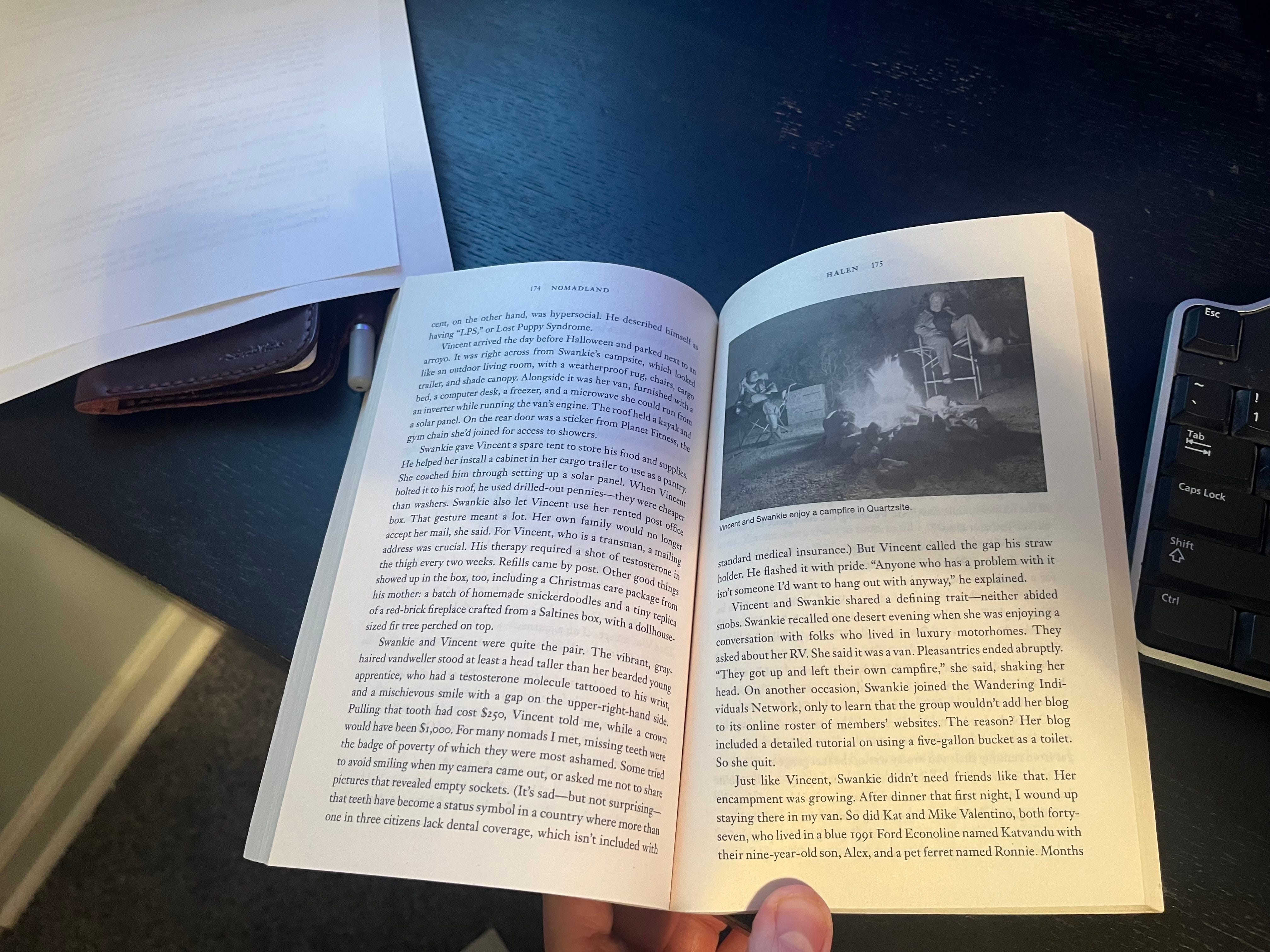
“Swankie also let Vincent use her rented post office box. That gesture meant a lot. Her own family would no longer accept her mail, she said.” 1
That was it. I guess I would have to wait for the movie for the rest.
Hulu finally released it. We got a seven-day trial and invited my parents over to watch. They had already seen the movie but didn’t want to cancel on us. They always looked for an excuse to spend time with my wife and me. My dad couldn’t help giving his commentary based on whatever insider knowledge he had gleaned from Charlene’s Facebook posts. He mentioned Charlene had driven her van to my childhood home after I moved out. He was impressed by the van’s solar panels she had installed herself.
The movie ended, along with any conversation about my family. It still didn’t feel like the kind of thing to ask too many questions about.
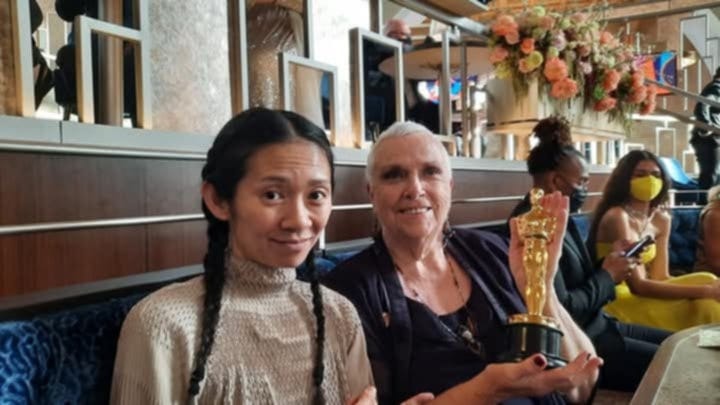
A few months later we all gathered in my basement again, this time to watch the 93rd Academy Awards Ceremony. Where Aunt Swankie, despite the COVID restricted Oscar ceremony, was attending alongside Director Chloé Zhao as her plus-one. She walked the red carpet. She sat between Zhao and Frances McDormand throughout the ceremony. She held Zhao’s Academy Award for Best Director. And when Nomadland was named the 2020 Best Picture, she was on the stage accepting the award alongside all the people who wanted to tell her story.
…
I didn’t get in touch with Swankie after her big night, at least not right away. Now that she was famous, it felt inappropriate. Like I was trying to latch myself onto her only after she was in this Oscar-winning movie.
But when my wife and I adopted three kids from Colombia, she sent me a Facebook message.
“Ok... I am trying to be patient waiting for photos. Are you home yet?”
I sent her a photo of our family and our three new children. She replied immediately.
“Oh my gosh! Wow wow wow. Tell them, i love them.”


Nomadland by Jessica Bruder, pg. 174


