


We have nothing but prairie.[1]
—Henrich Egge, early Grand Island settler
I grew up in Grand Island, Nebraska. If the name of our town is confusing to you, I understand. I’ve heard all the jokes and have made them myself. “It’s not an island and it’s not grand.” This isn’t the official city motto, but it might as well be. It would pair nicely with the State of Nebraska’s official tourism slogan: “Honestly, it’s not for everyone.” Yes, us Grand Islanders are fully aware of just how unremarkable we are. And we’ve come to terms with it. When I joined Facebook in 2008, our city couldn’t be selected as an option for “hometown” in your profile, so most of us just picked the closest alternative of “Grand Island, NY.” What’s a single letter difference in a state abbreviation?
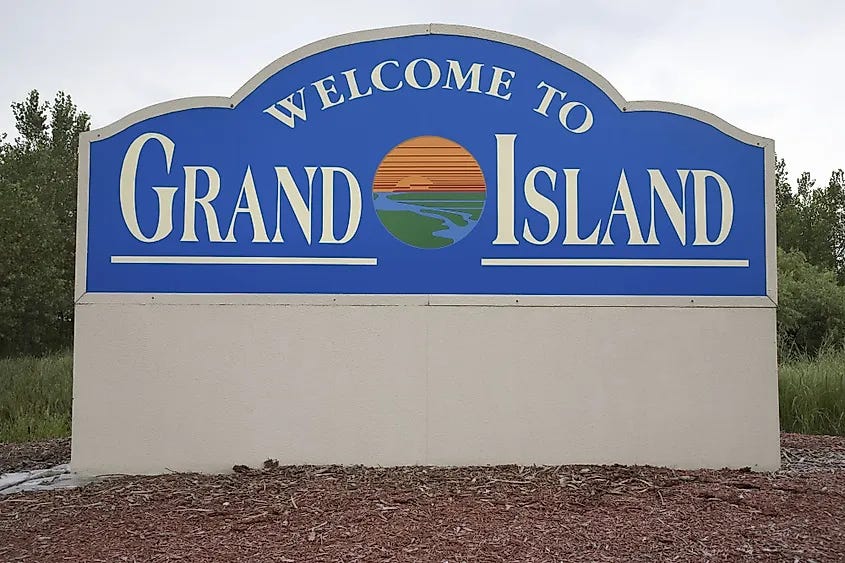
Nebraskans get sick of hearing how boring their state is when they introduce themselves. If Omaha is good enough for Warren Buffett it should be good enough for the snobby Southwest Airlines passenger crammed into the middle-seat who feels obligated to ask where you’re from. But honestly, once you get past the second entry in the list of city populations, it’s kind of true. According to year 2000 Census data—the year I turned ten and was given a cool “Census 2000” lapel pin from my fourth-grade teacher—there were only two towns in Nebraska with populations larger than the 85,000 people who filled Memorial Stadium in Lincoln each Saturday to watch Husker football. ESPN loved this factoid, and us central Nebraskans were thrilled to see the name of our city publicly shamed in a TV graphic each week listing the game attendance next to population figures of Nebraska residences.
Every small town has its thing—that unique identity that sets you apart on billboards and gas station pamphlets from all the other small towns that are otherwise facsimiles of one another. The 24,064 citizens of Hastings, Nebraska celebrate themselves as the birthplace of Kool-Aid and hold an annual summer festival that boasts “the world’s largest Kool-Aid stand.”[2]

North Platte, Nebraska with its 23,871 people is also a birthplace, but not of a delicious drink adored by millions, rather the used-to-be-famous showman Buffalo Bill. It doesn’t matter that he’s buried in Cody, Wyoming and the Buffalo Bills football team is in New York—North Platte gets to keep him. But if dead cowboys aren’t you’re thing, North Platte has also capitalized on the fact that they’re conveniently located off Interstate 80 with the “get closer to where you’re going” tourism slogan encouraging stopovers on the way to Denver.
The hideous stepchild of Nebraska is Kearney, where 27,431 people made a terrible life choice by living there. You may know the place from the Oregon Trail eight-bit video game and buying supplies at Fort Kearny. The fort was christened after Stephen W. Kearny, but the dumbasses spelled the name wrong when they named their town. Grand Island and Kearney don’t get along.
And then there’s us. The 42,940 Grand Islanders.
…
In fourth grade history, we were taught the superhero origin story of our great municipality. Sort of. I got the impression it was more of a generalization that Mrs. Saunder did from a historical marker she once read while pulled over to let her dog pee.
Located in the middle of the Platte River there was once a big ass island.
How big?
No one knows. It doesn’t exist anymore. It probably never did. But as settlers traveled across country in their covered wagons they would reference “Le Grande Isle.” [3]
Why were all the settlers French?
Can’t help you with that one either.
Why were the French settlers so bad at French, since “the grand island” in French is actually “I’isle grande”?
Seriously, stop asking so many questions.
My fourth-grade self never bothered to ask about these details. Ambition and curiosity don’t really have a place in Grand Island. And my fourth-grade self didn’t get a dog until he moved away to the city of Omaha, so that Rosetta Stone of roadside markers has yet to be rediscovered. Regardless, the “Le Grande Isle” town name stuck and got de-Frenched. And then people’s wagons broke down or they got bored or had to use the bathroom and pulled over, but one way or another ended up living—not on this grand island—but kind of in the general area. And now we have a town.
The reason no one definitively knows where the town name came from is because no one really cares about anything in Grand Island. People just kind of exist there. It’s a very conservative town, which I never minded, except when this brand of conservatism seemed to spill into a general lack of ambition overall. Which I did mind. When my high school classmate David Nance moved away and started a moderately successful rock band, he described our hometown in an interview as “more or less a strip mall, so basically Anytown U.S.A.[4]”
And the type of people who settle in Grand Island are the type who love strip malls.
That’s not to say Grand Island wasn’t full of good people. Nothing could be further from the truth. They were salt-of-the-earth types. They weren’t simple in a pejorative sense either, just in a statement-of-fact sort of way. I once had a coworker in his late forties say he would never move from his farm outside city limits into Grand Island proper because “GI is just too big.” When I mentioned I had vacationed to New York City, he was incredulous. He gave me a look as if I told him I had taken a trip to one of Jupiter’s moons. It was equal parts disbelief you could actually go there and disbelief that I was still alive upon my return.
It’s kind of a lot of people like that.
But even that description’s a bit misleading, because as a farmer, this guy knew who he was at heart. And he leaned into that. Most of us Grand Islanders don’t. At least I didn’t know who I was, and the people I spent time around didn’t either. The town proper has a population slightly under 50,000 and none of us are farmers. Some of us know farmers, but most are completely clueless about agriculture. I still don’t know what a silo is for. I once asked a farmer what they put inside a silo, and he replied “silage.” Which didn’t help.
To complicate things, Grand Islanders are not farmers in a state where everyone is assumed to be. All the “non-farmers” are supposed to live in Omaha or Lincoln. Yes, we have cornfields next to our mall, and our cemetery, and pretty much any vacant lot. You kind of forget about them. And once a year my parents took us to a farm supply store on “baby bird day,” the day when they sold freshly hatched chicks and ducklings to people who needed to buy freshly hatched chicks and ducklings. We never bought any, but there is no greater day than the day you can pick up a baby duckling from under a heat lamp clamped to the side of a corrugated feed trough and hold it as if it were your own. My sister did buy my brother-in-law a full-grown chicken as an engagement present though.
And my church hosted a “Harvest Party” in place of a “Halloween Party.” All of us kids dressed up in costumes, played games, and asked for candy. If this feels like a “Halloween Party,” you’re wrong. Halloween is for the devil. At our church, we celebrated harvest—and our party just happens to get scheduled each year on the Wednesday night prior to October 31st. It’s just a coincidence, ok?
But, other than that, there’s nothing farm-related about us.
…
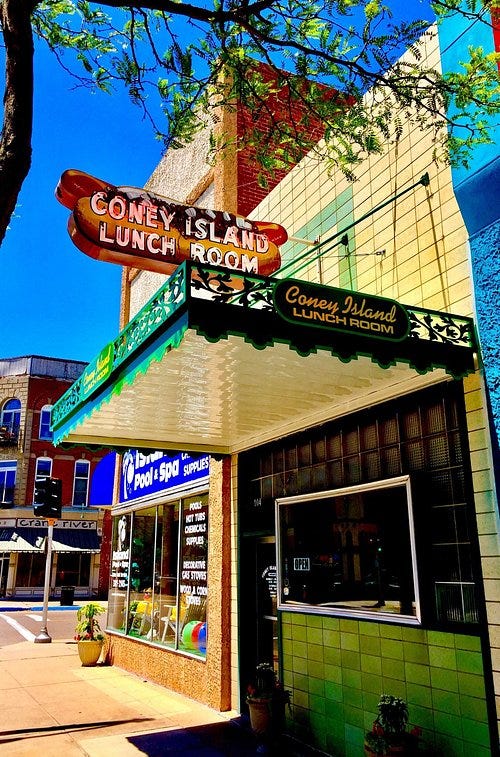
Grand Island has a few things uniquely ours. The most satisfying bout of diarrhea you’ll ever have comes after you taste the delicious chili dogs of the Coney Island Lunch Room. At least that’s the restaurant name according to the neon sign outside shaped like a chili dog—the menu, ninetieth anniversary drink koozies, and the banner for the racehorse they sponsor all say, “Coney Island Cafe,” but never “Café.” I don’t think anyone is aware of the inconsistency; we just call it Coney Island. The food here cannot be improved, unless you’re an out-of-towner, then you might be mistaken that a boiled hotdog covered in sliced onions, mustard, and meat product that is three quarters hamburger grease isn’t a delicacy. And you’d be wrong. The place opened in 1933 and little has changed since. The owner is the third-generation George Katrouzos, who took the restaurant over from his dad Gus Katrouzos, who took the place over from his dad George Katrouzos. George Jr. doesn’t have any kids and no clear succession plan, but he at least caved and started hiring people who weren’t related to him to make french fries. They’re not allowed to touch the pot of chili though. That’s a job for a Katrouzos.[5]
My Coney Island order is:
· two coneys with everything
· plate of fries
· strawberry malt (guide it out with a spoon)
Despite the local establishments that have been there forever, progress in Grand Island is marked by the arrival of new chain restaurants. With each Buffalo Wild Wings or Qdoba we felt one step closer to being a Big Boy—especially if the chain came to GI prior to hated rival Kearney, Nebraska. Yeah, fuck you Kearney. My life changed forever when Applebee’s and Perkins showed up. Applebee’s became my special date destination with my mom. Perkins was our new Sunday after church spot. I refuse to eat at either now, but back then I didn’t know there was something better. I didn’t need to know.
The arrival of chain restaurants represented stability in a town whose goal is to simply exist. That could also be a marketable slogan. “Grand Island: We Exist.” Whatever version of island life we lived, it was all we knew. It’s not that we didn’t want to change, we just assumed we weren’t allowed to. Our little town was insulated from the cultural influences that cross-pollinate big cities, so we kept up the old ways as long as we could and assumed they would last forever. And in the meantime, if you want to throw us a few new fast-food franchises along the way, it would mean a lot to us.
…
There’s a flavor of cynicism when I describe my birthplace, which isn’t intentional, but I can’t help it. To many Nebraskans, Grand Island was a destination. State Senator Colby Coash said he would travel “three hours south to Grand Island to have my braces tightened.” It was a treat for him to stop at the Conestoga Mall since he could buy Metallica cassettes and get his ear pierced, services his hometown of Bassett with a population of 1,010 didn’t offer.[6] I’m not ashamed of where I’m from. And I’m protective of it. But kind of in an only-I-get-to-talk-like-that-about-where-I-come-from kind of way. I wanted to get out for as long as I can remember, and I’ve never wanted to go back once I did. Grand Island made me who I am, and I’ve never desired to be anyone else. But I did feel meant for something else.
Somewhere else.


[1] Pete Letheby (ed.), A Commemoration of the Sesquicentennial of Hall County, Nebraska, (The Grand Island Independent, 2007) 22.
[2] World’s Largest Things, World’s Largest Kool-Aid Stand, accessed August 19, 2025, http://www.worldslargestthings.com/nebraska/koolaidstand.htm#:~:text=Hastings%20Nebraska&text=Not%20sure%20where%20that%20is,free%20versions%2C%20and%20new%20favorites!.
[3] A Commemoration of the Sesquicentennial, 29.
[4] Tim Scott, “Exploring the Ragged and Raw Rock ’n’ Roll of Nebraska Songwriter David Nance,” Vice Magazine, July 2, 2016, accessed August 19, 2025, https://www.vice.com/en/article/r3z3nk/exploring-the-ragged-and-raw-rockn-roll-of-nebraska-songwriter-david-nance.
[5] Lawrence Molczyk, Jean Lukesh and James Dean, What A Life!: The Epicurean Legacy of Three Generations of the Immigrant Katrouzos Family, (Coney Island Hot Dog Publishing).
[6] Colby Coash, Running Naked: Surviving the Legacy of Family in Rural Nebraska: A Coming of Age Memoir, (Cahoy & Crook, 2024), 51.


